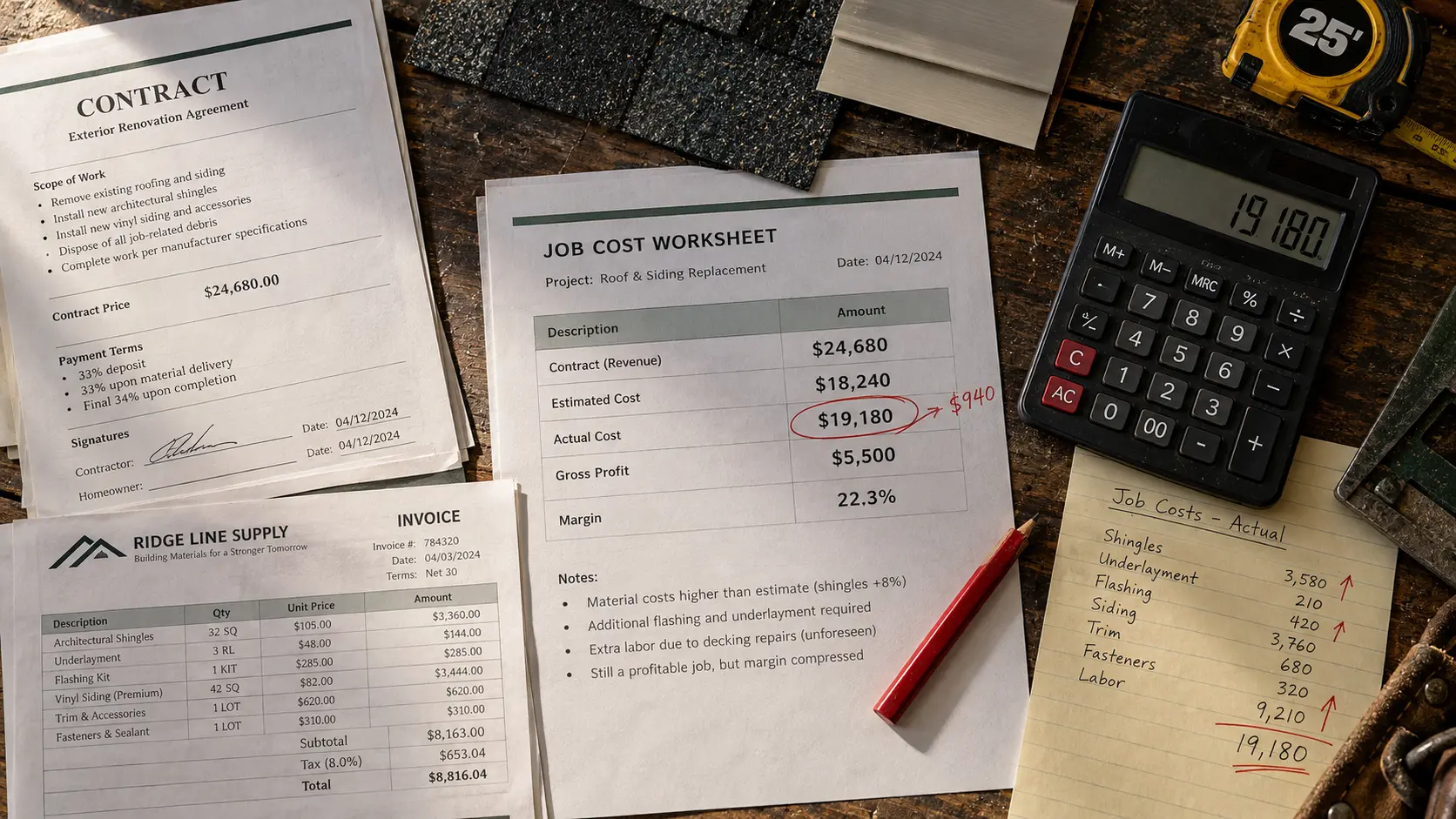
Exterior contractors are entering a dangerous kind of growth market: sales expectations are high, but the cost of delivering each job is harder to control.
ServiceTitan’s 2026 Roofing and Exterior Market Report found that 75% of surveyed contractors expect revenue growth and 74% expect higher profits. At the same time, one-third reported EBITDA margins between 6% and 15%, while labor, overhead, and skilled-worker shortages remain major concerns.
That tension matters. A company can sell more work, hire more people, and stay busier than ever—while quietly becoming less profitable.
Revenue is the loudest number in the company
Revenue is easy to celebrate. It appears on leaderboards, sales meetings, dashboards, and year-end recaps. Margin is quieter. It is often discovered after the supplier invoices arrive, labor runs long, materials are reordered, and the job is finally closed.
That delay creates a false sense of momentum. The company sees a signed contract for $25,000 and records a win. But production may see missing components, a material substitution, two extra crew days, and a callback. By the time accounting sees the real result, the sales team has already repeated the same process on several more jobs.
More volume does not repair that system. It multiplies it.
A bad job can look good at the sale
Most unprofitable jobs do not begin with an obviously reckless price. They begin with small assumptions:
- A price sheet that was never updated
- A product accessory that was omitted from the scope
- A waste factor copied from the wrong type of project
- Labor priced for the ideal installation instead of the actual property
- A proposal option that changed without updating the material plan
- A salesperson discounting the job without seeing its margin impact
Each decision may look minor on its own. Together, they determine whether the job creates cash or consumes it.
2026 is making mistakes more expensive
Roofing Contractor’s 2026 industry survey found that the economy and inflation, material costs, and qualified-worker shortages remain contractors’ leading business concerns. More than half of respondents reported increasing labor costs, with an average increase of 14%.
When labor is scarce, an unnecessary return trip costs more. When materials are rising, a stale price is more damaging. When homeowners are price-sensitive, there is less room to solve an internal mistake with a change order.
The contractor does not control the market. The contractor can control how quickly pricing, scope, and actual costs become visible.
Job costing is not an accounting exercise
If the only time a company learns the true margin is after the job closes, job costing becomes a historical report. Useful, but too late to change the outcome.
A better process treats projected cost as part of the quote and actual cost as a live operating signal. The team should be able to compare what it expected to spend with what the job is consuming—while there is still time to investigate.
That does not require a complicated financial model. It starts with four numbers:
- Contract value
- Projected material and labor cost
- Actual material and labor cost
- Expected versus current gross margin
When those numbers live in different spreadsheets, inboxes, and systems, the company spends its time reconstructing the truth. When they stay connected to the job, leaders can act on it.
The best jobs should shape the sales strategy
Many contractors evaluate salespeople by total revenue. That can reward the wrong behavior. A rep who sells fewer well-scoped jobs at healthy margins may create more value than a rep who sells aggressively and leaves production to repair the estimate.
The same is true of lead sources and service lines. A channel that produces high close rates may still be weak if the jobs require heavy discounts or regularly miss their projected cost. A smaller service line may deserve more investment if its quotes are repeatable and its margins hold.
Without job-level visibility, those decisions are made from instinct. With it, a contractor can pursue the work the company is actually good at delivering.
Do more with the team you already have
Industry research shows contractors are focused on labor optimization, material costs, and operational efficiency. That does not mean squeezing more activity out of an already stretched team. It means removing the work created by disconnected information.
A quote should not need to be rebuilt into a material order. Production should not have to interpret what sales intended. Accounting should not have to chase five systems to understand why a job missed margin.
Cleaner information creates capacity before another hire does.
Growth is only real when the margin survives
A growing backlog, a larger sales team, and a bigger revenue number can all be healthy signs. They are not proof that the business is becoming stronger.
The real test is whether the company knows what it expects to make, sees when a job begins moving off plan, and learns from the difference before quoting the next one.
More revenue can hide a bad job. It cannot fix one.